
British Standard Lock Upgrades Service — J D Locksmith
Your Insurance Policy May Have a Lock Requirement You Have Never Checked
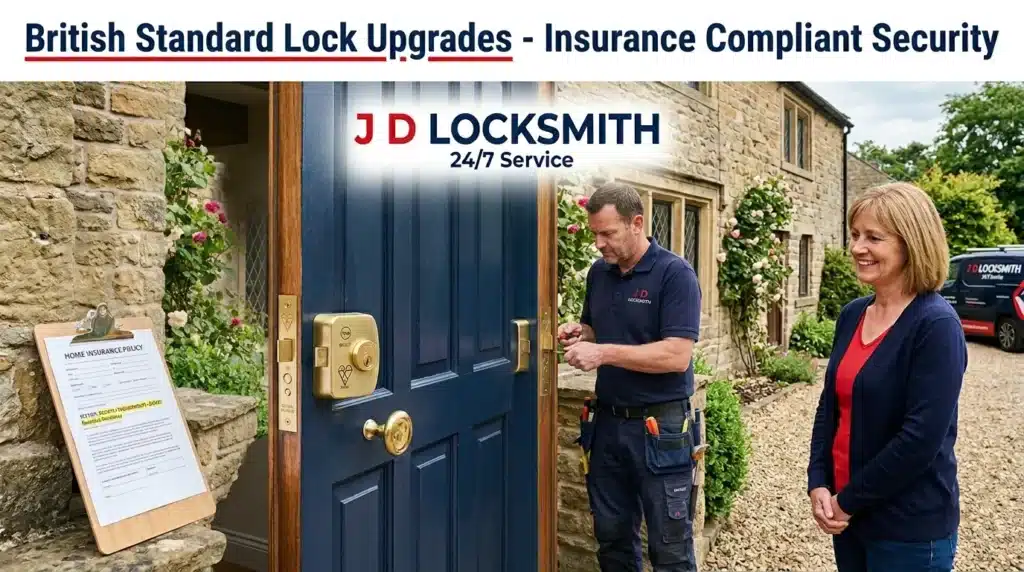
Most people take out home insurance, file the documents, and do not look at them again unless something goes wrong. When something does go wrong — a break-in, a forced entry, a claim — that is when the small print gets read carefully. And for a significant number of homeowners across the UK, that is when they discover that their locks did not meet the standard required by their policy.
A claim can be reduced or rejected entirely if the locks on your external doors do not meet the specification set out in your policy. Not because of anything you did wrong, but simply because the locks that came with your home do not carry the right certification.
At J D Locksmith, we check lock compliance for homeowners across Lancashire and Yorkshire every week. We tell you clearly what you have, what your insurer requires, and what needs to change. The upgrade itself is straightforward. The cost is modest. The protection it gives you — both against burglary and against insurance complications — is significant.
What Is British Standard BS3621?
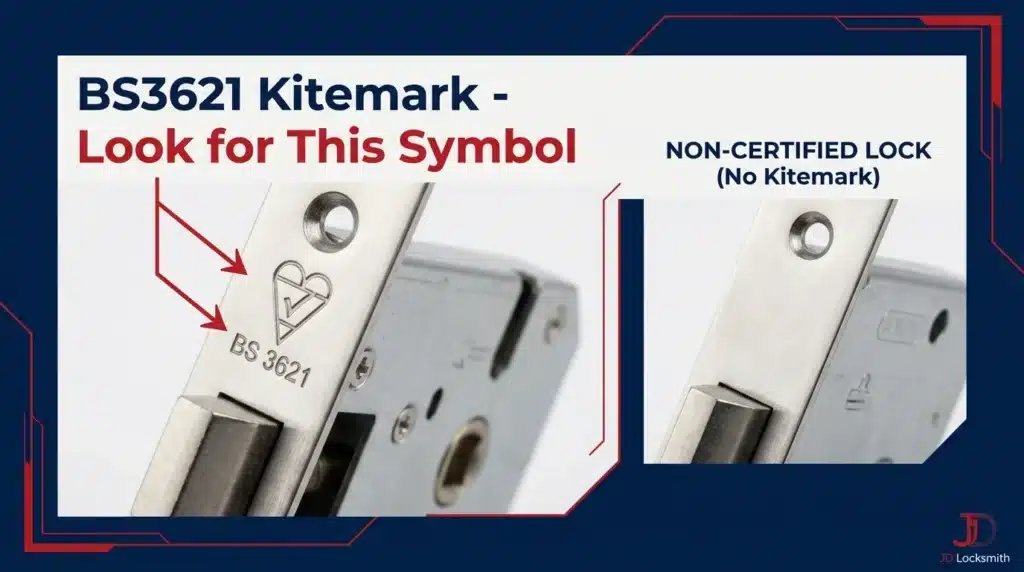
BS3621 is the British Standard specification for locks fitted to external doors in residential properties. It is set by the British Standards Institution and defines a minimum level of security that a lock must meet in terms of its resistance to common attack methods — picking, drilling, and forced entry.
A lock that carries the BS3621 kitemark has been independently tested and certified to meet those requirements. Most home insurance policies in the UK specify BS3621 as the minimum requirement for deadlocks on timber external doors. Some policies extend this requirement to all external doors regardless of type.
The marking to look for is the kitemark symbol alongside the number BS3621. It is usually stamped on the lock body or on the faceplate. If you cannot find this marking on your locks, there is a good chance they are not BS-certified.
What About uPVC Doors?

The situation with uPVC doors is slightly different, and homeowners are frequently caught out in this area.
Most uPVC doors do not use a traditional deadlock. They use a euro cylinder — the oval-shaped barrel that accepts the key — in combination with a multi-point locking mechanism. The cylinder is the critical component for insurance purposes.
For uPVC doors, most insurers now require one of the following:
- A euro cylinder that meets the TS007 3-star rating, which covers anti-snap, anti-pick, anti-drill, and anti-bump protection.
- A Secured by Design-approved cylinder, which meets the same criteria from a different certification route.
A standard euro cylinder — the type fitted to the vast majority of uPVC doors when they leave the factory — does not meet either of these standards. It looks identical to a compliant cylinder on the outside, but it lacks the internal protections that certification requires.
This is one of the most common compliance gaps we find. Homeowners have a uPVC door, assume it is secure, and have no idea that the cylinder inside it is both uninsured and vulnerable to lock snapping. Our anti-snap lock upgrades page explains the snapping risk in full detail — it is worth reading alongside this page if your home has uPVC doors.
Our uPVC door problems and repair guide also covers the most common faults we see on uPVC doors across Lancashire, including how cylinder wear develops over time.
Moving House? Check Your Locks Before You Assume They Are Fine
One situation where British Standard compliance comes up repeatedly is when people move into a new home. The previous owners may have had compliant locks — or they may not have. You have no way of knowing what was fitted without checking, and you may have already taken out an insurance policy that assumes compliance.
Our moving house locksmith checklist covers exactly this scenario. It walks through every lock-related check that is worth carrying out when you move into a new property — including how to identify whether your locks meet your insurer’s requirements. Booking a compliance check early gives you certainty before a claim is ever needed.
What the Upgrade Involves

Upgrading to a compliant lock is not a complex or disruptive job. Here is what it looks like in practice:
We check your current locks. We confirm what you have and cross-reference it against the specification in your insurance policy, if you have it to hand, or against the standard requirements that apply to most UK policies.
We give you a clear recommendation. If your locks are compliant, we will let you know, and the advice is free. If they are not, we explain exactly what needs changing and give you a fixed price before any work starts.
We carry out the upgrade. For timber doors, this typically means replacing the existing deadlock with a BS3621 certified alternative. For uPVC doors, we replace the euro cylinder with a TS007 3-star rated anti-snap version. Both jobs are completed quickly, usually within a single visit. More details on our full door lock service are on our door lock repair and replacement page.
We provide written confirmation. We issue documentation confirming the make, model, and certification standard of every lock we fit. This is worth keeping with your insurance documents.
Regular Security Checks Make a Difference
Lock compliance is not a one-time concern. Locks wear. Standards change. Insurance policies get updated. It is worth building a regular security check into your household routine — our spring home security checklist is a practical guide to the checks that are worth carrying out once a year, including reviewing your lock standards.
If you want a professional pair of eyes rather than a DIY check, our free security sweep covers more than that. We visit your property, assess every entry point, and give you a written summary of what we find — with no obligation to act on any of it.
Frequently Asked Questions about British Standard Lock Upgrades Service
How do I find out what my insurance policy requires?
Check the policy documents under “security conditions” or “lock requirements.” If you cannot find the specific wording, call your insurer and ask them directly. We are also happy to advise based on what we find when we look at your locks.
What does the BS 3621 kitemark look like?
It is a kite-shaped symbol with a tick inside, accompanied by the standard BS3621. It is usually stamped on the lock body, the faceplate, or the packaging. If there is no marking at all, the lock is almost certainly not BS-certified.
Are all five-lever mortice locks BS3621 compliant?
No. Having five levers is a necessary condition of BS3621 certification, but it is not sufficient on its own. A five-lever mortice lock can be manufactured and sold without being tested or certified. Only locks that carry the actual kitemark have been independently assessed to that standard.
I have a uPVC door. Does BS 3621 apply to me?
Not directly, but the principle is the same. For uPVC doors, the relevant standard is TS007 3-star for the euro cylinder. Many insurers specify this alongside or instead of BS3621. We check what applies to your specific door type and policy situation.
Will upgrading my locks lower my insurance premium?
Some insurers offer premium reductions for BS3621 or Secured by Design-approved locks. It is worth calling your insurer after the upgrade to let them know the new specification.
What areas do you cover?
We carry out lock compliance checks and upgrades across Lancashire, North Yorkshire, and West Yorkshire. We regularly attend properties in Skipton, Lancaster, Burnley, Kendal, Clitheroe, Rawtenstall, and across the wider area.
Areas We Cover
J D Locksmith carries out British Standard lock assessments and upgrades across Lancashire and Yorkshire. We work regularly across Burnley, Nelson, Colne, Barnoldswick, Skipton, Settle, Clitheroe, Rawtenstall, Bury, Lancaster, Morecambe, Carnforth, Kendal, Silsden, Cross Hills, and Cowling. Every assessment is carried out by us directly — no subcontractors, no franchises.
Find Out If Your Locks Are Compliant
It takes one visit and one honest conversation. If your locks are already up to standard, you will know for certain. If they are not, we can fix it the same day.
Call: 07745 665170
Email: dan@jdlocksmith.co.uk
A Local Locksmith for Local People.