
Landlord Autumn Checklist: Meeting Lock and Security Standards for Rental Properties in Colne
Landlord Autumn Checklist: Meeting Lock and Security Standards for Rental Properties in Colne
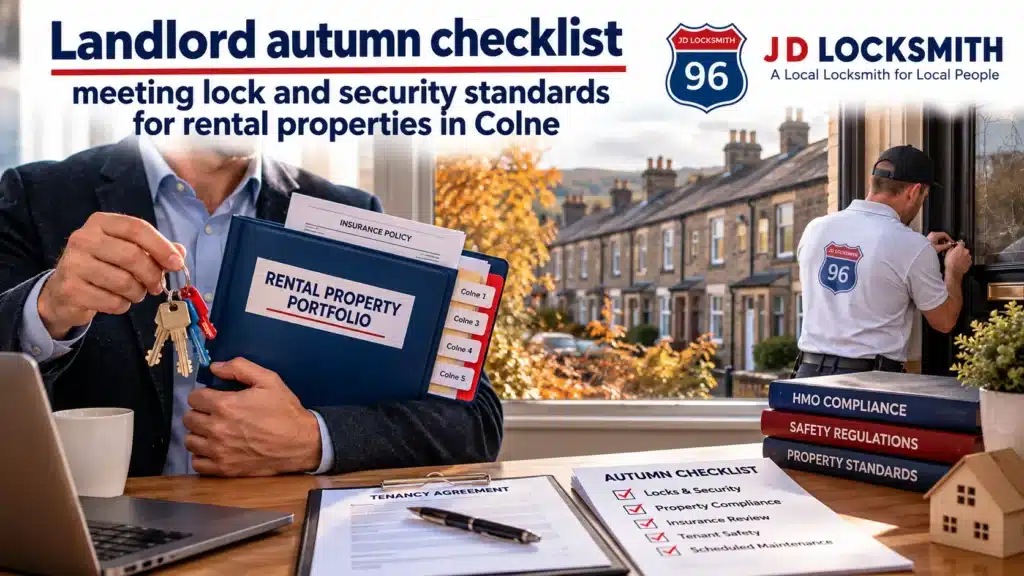
For a landlord, the security of your rental property is not only about safeguarding your tenants, but also about complying with legal requirements, satisfying your insurers, and protecting yourself against liability in the event of any problems.
Many landlords in Colne only realize there are gaps after experiencing a break-in, particularly when an insurance company examines the locks or when a tenant asks why the door was so easy to force. It’s then too late.
I’m Dan Collins with J D Locksmith, and I ensure standards are met. Once the busy period of summer tenant changeovers is over, settled tenancies show which properties were properly secured and which were rushed.
In October last year, a landlord from Colne contacted me after a break-in at a tenant’s flat. The insurance company questioned the claim because the front door had only a basic latch, not a British Standard lock. The landlord risked having his claim rejected, damaging his relationship with the tenant, and facing legal liability—all because a cheap-to-install lock was never fitted.
The checklist will take you through the locking and security standards that your Colne rental properties must meet. If you comply, you will protect your tenants, meet your insurer’s requirements, and guard yourself against liability.
What security standards should rental property meet?
External doors of rented properties must have British Standard locks, secure locks, lockable windows, and provide escape routes in the event of a fire. Houses in multiple occupation must meet further legal requirements. Meeting these standards helps protect tenants and satisfies most insurance policies.
Landlords’ security responsibilities span many areas because no single set of rules exists, which can create gaps. This is to meet legal requirements, comply with insurance terms, and fulfill the general obligation to keep tenants reasonably safe.
The core security standards for rentals:
- British Standard locks (BS 3621) on external wooden doors
- Anti-snap or British Standard cylinders on UPVC and composite doors
- Lockable windows with available keys, especially on the ground floor
- Safe fire escape that doesn’t trap tenants behind deadlocks
- Additional HMO requirements for shared houses
It is not expensive compared with the property’s value or the cost of getting it wrong, to have the locks right. The cost of a rejected insurance claim or a liability finding is much higher than properly installing the locks.
Why is compliance with locking requirements important for landlords?

Compliance with locking requirements matters because failing to provide adequate security could lead to rejected insurance claims, breach your duty of care to your tenants, and make you liable if a break-in results in loss or damage. Using compliant locks safeguards both your tenants and your legal position.
The situation is not just hypothetical. If a rented property is burglarized, both the tenant’s insurance company and yours will review the security arrangements. If the locks fell below reasonable standards, the insurer may challenge or reject the claim.
What inadequate locks can cost a landlord:
- Rejected insurance claims when locks don’t meet policy terms
- Liability for tenant losses if poor security enabled the break-in
- Breach of tenancy obligations to provide a secure home
- Damaged reputation affecting future lettings
- Deposit disputes and strained tenant relationships
The landlord in Colne whom I referred to found out the hard way. The anti-snap upgrade cost was only a small part of what the rejected claim and damaged relationship cost later.
What locks do UPVC doors on rental properties need?
Rental properties fitted with UPVC doors must have anti-snap cylinders at least. Standard cylinders can be snapped in seconds, and if they fail in a rental situation, the landlord could be held liable. Anti-snap cylinders represent a cheap upgrade and satisfy most insurance requirements.
In most properties let in Colne, the doors are UPVC, and many still have the simple cylinders fitted at the time of installation. In my view, standard cylinders are the most common security flaw in rental properties.
Cylinder snapping is a method criminals are well aware of. A standard cylinder offers almost no resistance and therefore poses a real risk in a rental property, since the tenant must provide reasonable security.
Why anti-snap cylinders matter for rentals:
- They defeat the most common UPVC attack method.
- They satisfy most insurance policy requirements.
- They demonstrate reasonable security provision.
- They’re affordable relative to the protection provided
- They protect your tenants and your liability position.
Upgrading cylinders across a portfolio is straightforward. For lock upgrades on rental properties in Colne, a locksmith can work through multiple properties efficiently.
What are the rules regarding houses in multiple occupation?

Houses used to accommodate more than one person must comply with stricter security and fire-safety regulations, including special requirements for door locks to enable safe escape. Doors along escape routes must open from the inside without a key, so tenants are never left trapped in a fire.
Because more people live in the building, HMOs have extra responsibilities, and the risk of fire is greater. The security arrangement must balance keeping intruders out with allowing tenants to escape quickly.
Key HMO security considerations:
- Escape route locks must open from inside without a key.
- Thumb-turn locks are often required on final exit doors.
- Individual room locks give tenants security for their belongings.
- Unsuitable locks must not compromise fire doors.
- Larger HMOs may need licensing with specific conditions.
Fire safety is most important; if a deadlock requires a key to open from the inside, it could trap tenants in a fire, which is why escape-route doors must have thumb-turn mechanisms. Making this mistake is not merely a matter of complying with regulations—it’s a question of life safety.
If you run HMOs in Colne, get professional advice to ensure your locks meet both security and fire-escape requirements, since these two requirements can conflict and need expert resolution.
When should landlords replace locks when tenants change?
Landlords should change or rekey locks each time a new tenant takes over. Since previous tenants, their partners, friends, and visitors may have had keys, change the locks when a tenant changes so theso that the new tenants are the only ones with access, protecting them and reducing the landlord’s liability.
It is one of the most neglected landlord duties, as locks often remain unchanged across several tenancies, and keys that still work may have been held for years by previous tenants.
Why changeover lock changes matter:
- Former tenants may have kept or copied keys.
- Their partners and friends may hold copies too.
- You cannot track how many keys exist after a tenancy.
- New tenants deserve to be the only key holders.
- Failing to change locks could expose you to liability.
Summer is when most changes happen, and many are rushed or skipped. By autumn, tenancies have settled, so use this time to ensure all properties had their locks changed properly at the last changeover, and address any cases where this was overlooked.
It is quick and cheap to replace an UPVC cylinder. By grouping these tasks during the changeover process across a range of projects, you can keep them under control and ensure no property is overlooked.
How Should Landlords Manage Keys Across a Portfolio?
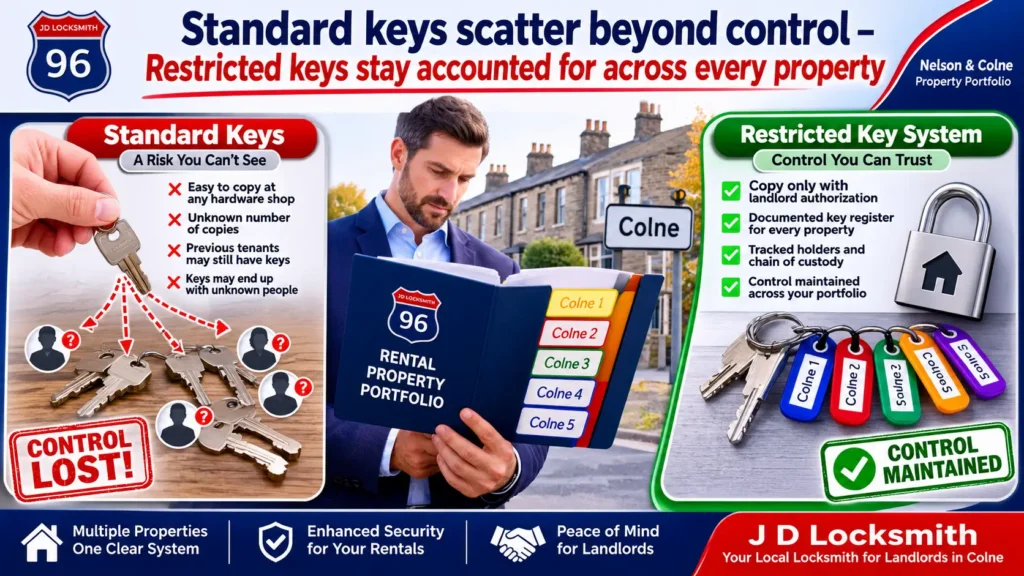
Landlords should manage keys with a clear tracking system recording which keys exist for each property and who holds them. Consider restricted key systems that prevent unauthorized copying to maintain access control.
Key management gets harder as a portfolio grows. Without a system, you lose track of how many keys exist, who has them, and which property they open. This loss of control is a security risk in itself.
Good key management practices:
- Keep a record of keys cut for each property.
- Track which keys are held by tenants, contractors, and agents
- Collect all keys at the end of each tenancy.
- Consider restricted keys that can’t be copied without authorization.
- Change locks when key control is ever in doubt
Restricted key systems are particularly valuable for landlords. Standard keys can be copied at any hardware shop. Restricted keys can only be cut with your authorization, so you always know how many exist. For portfolios across Nelson and Colne, this control is worth the investment.
What is the complete autumn landlord security checklist?
An autumn security checklist for landlords should cover door locks, window locks, fire-safe escape routes, key management, and insurance compliance for each property. Going through this checklist every autumn ensures stable tenancies are adequately secured before winter.
Use this checklist for each Colne rental you own:
Door Locks
- British Standard locks on wooden external doors
- Anti-snap cylinders on UPVC and composite doors
- Locks changed at the last tenant changeover.
- All external doors covered, including side and utility doors
Windows
- Lockable windows with available keys
- Ground floor windows prioritized
- Keys provided to tenants and recorded.
Fire Safety
- Escape routes open from inside without a key.
- Thumb-turn locks on final exit doors where needed
- Fire doors not compromised by unsuitable locks.
- HMO-specific requirements met
Key Management
- Record of keys for each property
- All keys collected at previous changeovers
- Restricted key system considered for portfolio
- Locks changed where key control is uncertain.
Compliance
- Locks meet insurance policy requirements.
- Security satisfies tenancy obligations.
- HMO licensing conditions met where applicable
- Documentation kept for insurance purposes
Common Questions About Landlord Security Standards
Is it the law that landlords should change the locks when tenants move out?
What lock standard is required for rental properties to have insurance?
What fire safety rules apply to locks in shared houses?
Who should be held responsible for a burglary of a rented property caused by a faulty lock?
Should landlords fit individual locks to bedroom doors in shared houses?
What methods can landlords use to prevent key copying at their various properties?
Protect Your Tenants and Your Investment
Rental property security carries responsibilities that owner-occupied homes don’t. You’re not just protecting a building. You’re meeting legal duties, satisfying insurers, and safeguarding people who trust you to provide a secure home.
The Colne landlord whose claim was rejected learned that lock compliance isn’t optional paperwork. It’s the difference between a covered loss and an expensive liability. The upgrade that would have prevented the whole situation cost a fraction of what the gap ultimately cost.
Autumn, after the summer changeover rush, is the ideal time to check that every property meets standards before the higher-risk winter months and before insurance renewals.
Own rental properties in Colne? Call me at J D Locksmith on 07845 08 66 31 for a landlord security review.
I’m Dan Collins, serving Colne, Nelson, Barnoldswick, and all of Lancashire and Yorkshire. I help landlords meet security standards and protect their properties, tenants, and liability position.
I’ll assess each property’s locks, identify compliance gaps, handle changeover lock changes, and advise on key management and HMO fire-safe requirements. Efficient work across portfolios from a locksmith who understands landlord obligations.
Don’t wait for a break-in to discover a compliance gap. Get your Colne rentals checked this autumn and let every tenancy run on a properly secure foundation.